

Buy now
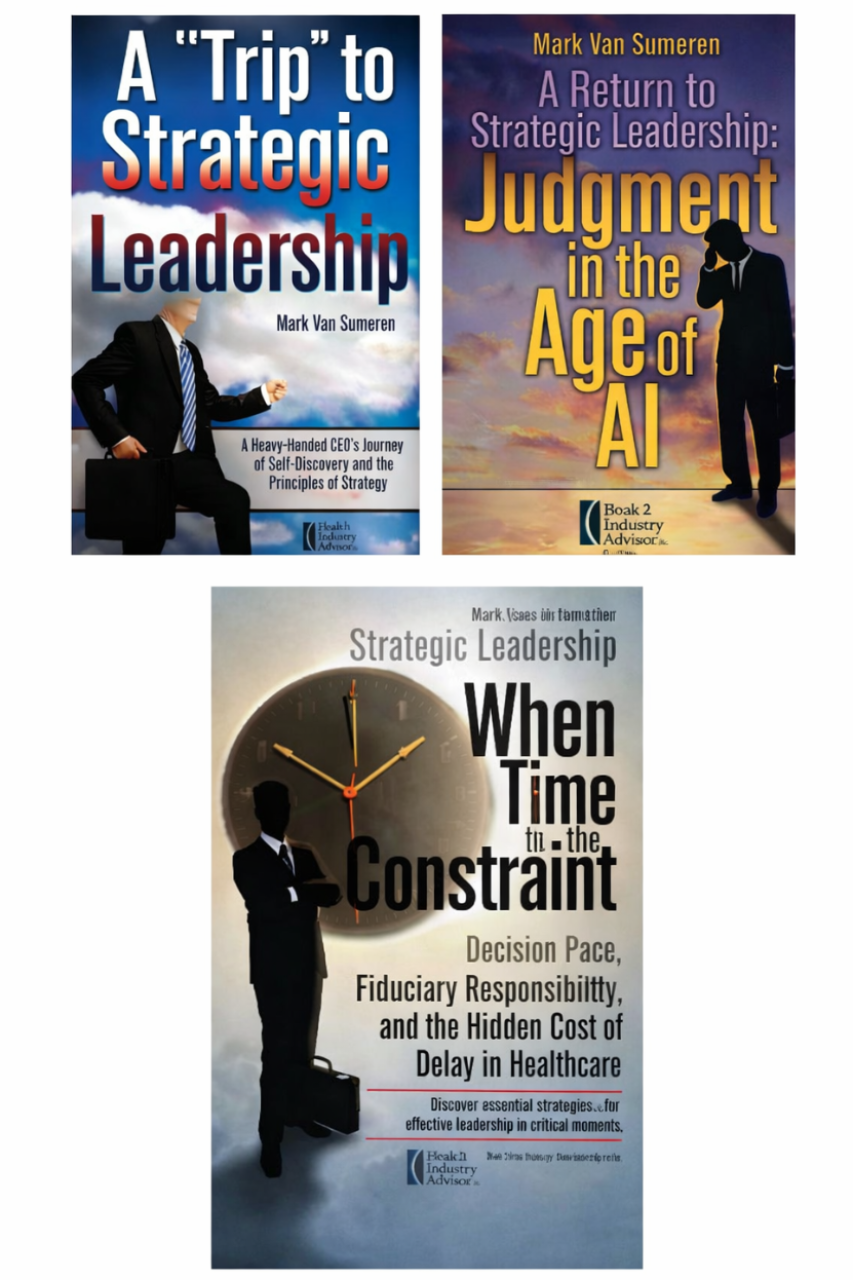
Book2Look for The Strategic Leadership Trilogy
The Strategic Leadership Trilogy
The Strategic Leadership trilogy examines how leaders and institutions make consequential decisions when certainty is unavailable, time is not neutral, and accountability cannot be deferred. Rather than offering frameworks or prescriptions, the series uses rigorously grounded business fiction to explore the moments when capable leaders discover that intelligence, intent, and values are no longer sufficient to produce durable outcomes. Across all three books, the focus is not on failure in crisis, but on underperformance that accumulates quietly—through delay, diffusion of responsibility, and systems that make inaction rational.
The trilogy unfolds in three movements. A Trip to Strategic Leadership begins with the individual leader, confronting the limits of authority, urgency, and experience as substitutes for judgment. A Return to Strategic Leadership: Judgment in the Age of AI shifts the lens to decision-making in an era of accelerating intelligence, asking what responsibility remains when machines inform—and often pressure—human choice. The final volume, Strategic Leadership When Time Is the Constraint, turns outward to institutions themselves, revealing how governance design, decision pace, and fiduciary structures determine whether organizations can act while meaningful options still exist.
Read together, the series advances a single, unifying
argument: leadership is not defined by heroism, insight, or even
judgment alone. It is defined by whether systems are designed to
surface truth early, enforce timely choice, and endure beyond the
individuals who lead them. In complex, mission-driven, and highly
regulated environments, the most important leadership decisions are
often the ones that shape how future decisions will be made—or
avoided.
A Trip to Strategic Leadership
Book One
The first volume introduces a successful, forceful CEO whose habitual ways of leading are no longer producing results. Through an unexpected pause that becomes a journey of self-examination, the book explores the foundations of strategic leadership—clarity, restraint, and purpose. Less about techniques than transformation, it challenges the assumption that authority, urgency, and experience are sufficient substitutes for judgment. The book establishes the series’ central question: what does it actually mean to lead strategically?
A Return to Strategic Leadership: Judgment in the Age of AI
Book Two
As artificial intelligence accelerates analysis and amplifies certainty, the second book asks what remains uniquely human in leadership. Set inside a global professional services firm confronting technological disruption, the story examines how judgment, responsibility, and ethical choice become more—not less—important when machines shape decisions. The book argues that AI does not replace leadership; it exposes it, forcing leaders to confront where accountability ultimately resides.
Strategic Leadership When Time Is the Constraint - Available July 2026
Book Three
The final volume turns from individuals to institutions. Through a business novel grounded in modern healthcare, it reveals how governance systems quietly reward delay, diffuse accountability, and allow unresolved decisions to consume capacity. The book introduces a central insight with broad relevance: decision pace is capacity. When time is left ungoverned, organizations erode not through failure, but through underperformance that society ultimately pays for.